
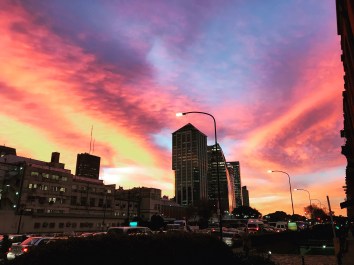
 The Argentinian Lifestyle
One has simply got to love the Argentinian hospitality and friendliness. It’s almost impossible to invite your tutor to a coffee when you’ve just arrived to the city because they’re going to insist on paying for you. Getting lost anywhere is just as unthinkable, since at least three people will walk up to you to ask if they can help you find your way. Don’t you dare walk past someone you know, only waving hi without greeting them properly with a kiss on the cheek. And if you ever need anything whatsoever anytime no matter the time of the day or the year or how crazy your request might be – you can rest assured that the “Porteños” will help you out.
Overall, “tranquilo” is the motto of basically everyone and everything here. When setting a date for 3pm, don’t expect your friends to show up before 3:30/4pm, and if the party starts at 11pm, it’s perfectly fine to arrive at 1am. Whether it might be at the cashier at the supermarket, doing group work in class or waiting for the elevator, here in BA, everybody’s got a little more time. And even if you actually don’t have it, you’ll make time. Where’s the point in rushing things?
That being said, life in Buenos Aires is very laid back. Although efficiency might not be the Porteños’ prime quality, leaving for class at 15:10 when it started at 15h, and taking a nap until 11pm before the party definitively has its perks. And while we’re still trying to figure out how those perfect queues at the bus stops are formed, and what time is actually appropriate and not too early or too late to arrive to a meeting, we’re simply enjoying the relaxed lifestyle and laid back attitude of Buenos Aires and its people. It definitely saves a lot of nerves and probably prevents some wrinkles, living by this “it’s all gonna work out eventually, and if not today, then tomorrow”-attitude, and we are currently embracing it to the fullest. Therefore, it’s pretty safe to say that we are in love with this lifestyle, this city and its people!
Groceries
Be warned: food and groceries at supermarkets are generally more expensive than in Germany. On top of that, milk products, such as yoghurt, cheese, and milk will cost almost twice as much in BA. Luckily, there’s the good ole Chino to save all of us some money. These little Chinese-run convenient stores can be found at every corner and offer everything from cheap wine to your favorite breakfast cornflakes, and usually at a much lower price than “Carefour Express”, “Coto”, “Dia”, “Vea” and Co. Don’t be deceived by the outer appearance of the shabby shops: they’ll become your best friend when only one ingredient is missing for your dinner at 10pm or you quickly need another bottle of wine for the “Previa” (Pre drinks). Other facts around food and grocery shopping include:
– Of course there are also products that are cheaper than in Europe, e.g. high quality meat and wine. So treat yourself to two of the greatest things Argentina has to offer.
– You can’t “just quickly” do your grocery shopping. Waiting in line at the cashier forever is part of the procedure, and paying by credit card will add another 5 minutes onto that eternity. “Tranquilo, tranquilo” is the motto, as always.
– Fruit and vegetables are something you probably won’t find at your Chino, but rather next door at your Verdulería. Greens and fruits can be bought at low prices and the quality is usually pretty good.
– The Kiosko should be added to your list of ‘go-to-places’ when in need of anything. During the day, you might want to charge your “Sube” (public transportation card) or phone prepaid card, get a snack or buy some water. While at night, you’ll order your coke or sparkling water after a night out through a little window at the door of the Kiosko, since the regular entrance will be closed at night. Although they’re not allowed to sell alcohol, you can ask for a bottle of beer and you’ll receive it in a very sneaky paper bag.
Living
As students of the economics faculty, living in Recoleta is the perfect location to quickly get to class, but also reach all the bars and clubs in Palermo at night. Coming to the city as a tourist, staying in Palermo directly would probably be the better choice, since most of the places to go out at night are located in this area. As a foreigner, just make sure not to stay in districts, such as “La Boca” or “Once”.
Generally, shared student apartments or Airbnbs can be found for €300-600. We found our apartment on Airbnb, and each paid €300 per month, while our temporary home was only 3 minutes walking from the economics/medicine faculty – perfect location in Recoleta and I could only recommend it!
Money & Azimo
Unfortunately, you’ll always have to pay €4-6 when withdrawing money at any ATM in the city, and a maximum of only €150 can be withdrawn – even, if you have the very convenient German DKB credit card (with which you can usually withdraw money for free worldwide). A cheap alternative to the regular cash withdrawal is Azimo. You simply register online, enter your credit card details, choose an amount, and your money will be transferred within 30 minutes. The first transaction is free, and the following costs only €3, while you can transfer as much money as you like. The money can then be picked up at one of the “Argenper” shops in the city. Don’t forget to bring your passport and walk home fast with all that cash in your pockets.
Paying by credit card is not only a struggle when buying groceries. At any restaurant, cafe, or shop it’ll take much longer, if you’d like to use your card instead of paying “effectivo” (cash). For some reason, credit-card-use-security is at an advanced level in this city and you have to put in your pin, as well as sign the receipt. All that takes an eternity, and you’ll sure be faster if you simply pay in cash.
Overall, you can expect a price level similar to that in Europe. Groceries are generally more expensive, going out to eat and drink is usually cheaper and public transportation is more or less for free in comparison to German trains and busses. But of course, wanting to try everything, be prepared to spend more money than at home.
Nightlife & Palermo
No doubt, all the best places to go out to eat, have coffee, party or dance can be found in Palermo. I’ve never seen an area as densely packed with cafes, bars, restaurants, and clubs as Palermo. During the day it’s already impressive how many cafes and restaurants can be found on the streets. But at night, when all the lights are on, the bars set up their tables outside, and the streets quickly fill up with people, the real Palermo vibe begins to set in. Even if you don’t have any plans for the night yet, you can simply stroll down the streets of Honduras and Costa Rica, or choose from one of the bars at Plaza Serrano. Whichever direction you decide for, I promise that you’ll find what you’re looking for on the streets of Palermo.
However, don’t expect to find any people in the bars or restaurants before 10pm. Typically, pre drinks start around 11pm, and those who go to the clubs before 2am will find themselves alone on the dance floor. Due to these late starting times, I can only recommend an evening nap before going out – you’ll thank me later when you have to make it until 6 or 7am every night.
Once you’ve danced the night away and are ready to go home, bus number 39 might become your best friend, just like it became ours. After a quick “Shawarma” snack (kebab Argentinian style) at the next corner, you can catch this bus on Costa Rica street – close to many of the most famous bars and clubs – and it drives all the way down Avenida Santa Fe. Depending on where you live in Palermo or Recoleta, the 39 might be a cheap and convenient alternative to an uber – which, of course, would also be very affordable way of getting home.
Public Transportation
A ride on a bus or the Subte (Metro) costs as little as €0,35 ($6,50-7,50 pesos) and can conveniently be paid with the blue Sube card (public transportation card). This card can be bought for €1,20 ($25 pesos) at any Kiosko and you can charge it at the same store or inside the metro stations.
The Subte system is very small and clearly structured, consisting of only 8 different lines. However, due to its small reach, sometimes it just doesn’t get you where you want to go. Although google maps will show you arrival times of up to an hour (from which you can easily subtract 10-20 minutes in reality), taking the Colectivo (bus) is often the quicker and more convenient alternative. Once you’ve found the right bus number, it’ll drop you exactly in front of where you want to go and within a week you’ll have figured out which bus takes you where. Only challenge every time you take the bus: finding the bus stop. Don’t trust google maps for their locations and rather ask a local where a certain bus leaves. Once you’ve found it, position yourself half on the sidewalk, half on the street and hold out your arm as far as possible to stop the bus when it’s approaching. Even if all other 6 people waiting at the “Parada” (bus stop) are doing the same thing – better safe than sorry.
Although Uber is illegal in Buenos Aires, everybody uses it and an Uber car will be available within 5 minutes if you order one. Prices are very low compared to Europe, but slightly higher compared to the rest of South America. A 15-minute ride from Recoleta to Palermo costs between $60-160 (€3-8), depending on the time of the day and demand.
SIM Cards
There are 3 different companies from which you can buy a prepaid SIM card: Claro, Movistar and Personal. The easiest way to get your “Chip” (SIM card) is going to an official store – make sure it’s the main store and not just some little shop, they won’t be able to help you there. I went to the Movistar store, the service was super friendly and quick, the SIM card is for free, and I was online after 20 minutes. Don’t forget to bring your passport as you’ll need to present it to the employee to receive your card. A couple of clicks on the computer, putting the SIM card into your phone, and shortly after you’ll receive a message that your SIM has been activated. You can charge it with whatever amount at the next Kiosko and automatically a plan will start that charges you $7,50 pesos (€0,36) each day for 50MB of internet. If you’ve used all your internet for the day, there’s the option to pay another $7,50 for an extra 50MB by simply replying to a text they’ll send you. If you don’t want to pay again, your internet will simply be slowed down, but WhatsApp is still fine to use. Ultimately, this prepaid card will cost you about €11.
Another option is Personal. It basically works the same way but apparently this provider has its issues with iPhones. Two of my friends with Samsung phones activated their chip without any trouble, while I had to go back to the store multiple times, and in the end it still didn’t work. With Personal there’s a package you can buy for $109 pesos (€5,30) that gives you 50MB of internet per day for one month. Since this is half the price of what Movistar offers, it might be an option for all of you Android users out there. If you have an iPhone, saving €5 a month might not be worth the struggle of getting your chip to work with your phone.
Useful Information
– You can almost always use German plugs without having to use an adapter. Only sometimes will you find an outlet that has the diagonal little holes instead of the round ones that are used in Germany.
– When going to official places, to get for example your SIM card, or to receive/change money, always make sure to bring your passport – an ID or copy of your passport will not be accepted.
– When looking for certain products you cannot find at the supermarket, such as yoghurt (as we know it from Europe), protein powder, nuts, or Gluten Free products, you might want to check out one of the many Diéticas shops. The most famous brand is Vitalcer and you can find shops on almost every big street. Although a bit pricy, they have a lot of great products, e.g. Dahí yoghurt and yoghurt drinks.


 lenacatherine