
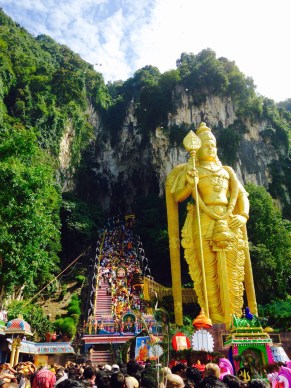
 What we experienced today was probably a once-in-a-lifetime kinda thing and I don’t think anything I write would even get close to reality, so I hope the pictures speak for themselves and the information further down gives y’all an idea of what was going on. Let me just say that my jaw was dropped most of the time, out of astonishment, fear, amazement, confusion. I just felt overwhelmed – like all the others from our group – and extremely privileged to be there and whiteness something so unique and special that gave us a deep insight into these people’s religion and traditions.
They truly believe in everything that’s happening there and it’s just amazing to watch and experience something that intense.
Thaipusam is a Hindu festival celebrated mostly by the Tamil community on the full moon in the Tamil month of Thai (January/February). It is mainly observed in countries where there is a significant presence of Tamil community such as India, Sri Lanka, Malaysia, Mauritius, Singapore, Guadalupe, Indonesia, Thailand and Myanmar.
In Malaysia, the temple at Batu Caves, near Kuala Lumpur, often attracts over one million devotees and tens of thousands of tourists. The procession to the caves starts at the Sri Mahamariamman Temple, Kuala Lumpur in the heart of the city and proceeds for 15 kilometres to the caves, an 8-hour journey culminating in a flight of 272 steps to the top. Devotees carry containers containing milk as offering to Lord Murugan either by hand or in huge decorated carriers on their shoulders called ‘kavadi’. The kavadi may be simple wooden arched semi-circular supports holding a carrier foisted with brass or clay pots of milk or huge, heavy ones which may rise up to two metres, built of bowed metal frames which hold long skewers, the sharpened end of which pierce the skin of the bearers torso. The kavadi is decorated with flowers and peacock feathers imported from India. Some kavadi may weigh as much as a hundred kilograms. After bathing in the nearby Sungei Batu (Rocky River), the devotees make their way to the Temple Cave and climb the flights of stairs to the temple in the cave. Devotees use the wider centre staircase while worshippers and onlookers throng up and down those balustrades on either side. When the kavadi bearer arrives at the foot of the 272-step stairway leading up to the Temple Cave, the devotee has to make the arduous climb. Priests attend to the kavadi bearers. Consecrated ash is sprinkled over the hooks and skewers piercing the devotees’ flesh before they are removed. No blood is shed during the piercing and removal.
– source: wikipedia


 lenacatherine